
In Allen v. Doiron, 2026 NBKB 049, the Court of King’s Bench assessed damages of $3.3 million for an 18-year-old woman thrown from a car in a high-speed rollover. She suffered spinal fractures, a brain injury and severe psychological trauma. It is the largest personal injury trial decision in the region’s history.
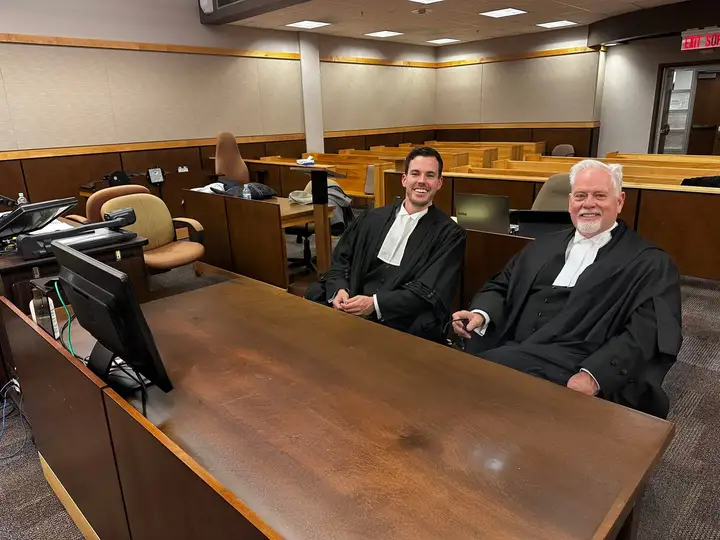
Aodhan P. Murphy and Michael B. Murphy, KC of the Mike Murphy Law Group represented the plaintiff, Kelsey Allen, through a ten-day trial in Moncton.
The Car Rolled Seven and a Half Times and Threw Her Clear
On October 10, 2015, the plaintiff was a passenger in a car at highway speed between Moncton and Sackville, New Brunswick. The car lost control, rolled seven and a half times, and stopped in the opposing lane. She was thrown clear and found unconscious in the median. Another passenger was killed. Her father reached the scene before the paramedics.
Her orthopedic surgeon put the force at about 25,000 foot-pounds of energy.
She Suffered Spinal Fractures, a Brain Injury and Permanent Impairment
She fractured her cervical spine at C6 and C7, her thoracic spine at T1 and T5, and her pelvis. The cervical fracture was unstable and needed surgical fusion to prevent further neurological injury or death. The ejection and impact caused a concussion consistent with a mild traumatic brain injury.
Chronic daily pain followed in her neck, back, shoulders and pelvis. She was diagnosed with PTSD, major depressive disorder, generalized anxiety disorder, panic attacks and mild neurocognitive disorder. On neuropsychological testing she scored in the second percentile for learning new information from one exposure, with severe deficits in immediate memory.
Before the accident she captained her high school soccer team, played for her province at national competitions, had three athletic scholarship offers and was applying to university to become a teacher. After it she could not hold a job or finish a college program, and nearly a decade later still depended on her mother for housing and money.
The Defence Blamed Pre-Existing Depression and the Court Rejected It
The defendant admitted liability and fought causation and damages. The defence retained a psychiatrist and a physiatrist, each of whom saw the plaintiff once, years after the crash. Their position was that her problems came from pre-existing depression, lifestyle, deconditioning and the stress of litigation.
The Court Gave the Two Defence Assessments Limited Weight
Justice Christa Bourque gave both assessments limited weight. The psychiatrist’s assessment lasted about 65 minutes, 40 of them by telephone after technical problems. He ran no standardized tests, kept no working notes and could not produce his draft report. He concluded her PTSD was in remission, against the diagnoses of every treating professional over nearly ten years. The court found him evasive in cross-examination.
The physiatrist agreed the fractures had healed but could not explain the ongoing pain, and put it down to myofascial issues and deconditioning rather than the trauma of ejection at highway speed.
The court preferred the treating family physician, the treating psychologist, the neuropsychologist, the orthopedic surgeon and the functional capacity evaluator. All of them had documented severe impairment through standardized testing and years of treatment.
The Court Found a Thin Skull Case Under Trainor v. DeArcos
The court applied Trainor v. DeArcos, 2025 NBCA 131, the Trainor v. DeArcos personal injury result on appeal this firm won three months earlier. Chronic pain, psychological injury and cognitive impairment are foreseeable consequences of a serious motor vehicle accident. The plaintiff’s earlier situational depression, which her own physician called mild, improving and common among teenagers, did not break the causal chain. This was a thin skull case. The defendant took the plaintiff as he found her.
The Damages in Allen v. Doiron: $3.3 Million Assessed by the Court
The court assessed total damages of $3,335,800:
- General damages for pain and suffering of $200,000, for permanent physical pain, psychological injury, lost independence and the loss of her planned teaching career.
- Past loss of income of $72,262, from the date she would have started teaching to trial, on forensic accounting evidence.
- Future loss of income of $2,139,210, the full loss of a teaching career to age 60 with no residual earning capacity. The court found she cannot sustain even part-time sedentary work.
- Loss of pension of $385,457, the net value of the New Brunswick Teachers’ Pension Plan she will never receive, including the bridge benefit from 60 to 65.
- Future cost of care of $492,895 for pain management, psychological therapy, medication, exercise supervision, sleep equipment and assistive devices for life.
- Past and future loss of valuable services of $45,976 for household help since the accident and into the future.
The plaintiff was not wearing a seatbelt. Section 265.2(1) of the New Brunswick Insurance Act imposes a mandatory 25% reduction where that failure contributed to the injuries. After the reduction and the addition of costs, the final award was $2,593,195.
The Court Made Four Findings That Matter for Future Claims
This New Brunswick car accident case produced four findings that matter for future ones.
No residual earning capacity. The functional capacity evaluation showed she could not hold a seated position for a working day. Her attempts at service jobs showed motivation, not capacity.
Teaching career lost. Her co-op placement, scholarship offers and university applications proved the plan was real and likely. The income and pension awards were built on that career, not on generic employment.
Defence assessments limited. A single session years after the accident, without standardized testing, and contradicting a decade of treating evidence, carries little weight.
Mitigation rejected. Intermittent work, college attendance and regular exercise were reasonable efforts. The standard is reasonableness, not perfection.
The Court Preferred Seven Treating Witnesses to Two Defence Assessors
The plaintiff called seven medical and professional witnesses who had treated or assessed her over nearly ten years. The defence called two assessors who had seen her once each.
Neuropsychological Testing Showed Second-Percentile Verbal Learning
The second-percentile verbal learning score means she learns new information from a single exposure less effectively than 98% of the population. With her chronic pain and psychological conditions, that finding grounded the conclusion that she has no meaningful residual earning capacity.
The Defence Psychiatric Assessment Failed on Five Grounds
Sixty-five minutes, forty of them by phone. No standardized tests. No working notes. No draft report. A conclusion of “in remission” that no treating professional shared. Evasive answers in cross-examination. The court gave it limited weight on each of those grounds.
The Insurance Act Cut the Award by 25% for the Missing Seatbelt
Section 265.2(1) of the Insurance Act requires a 25% reduction where the plaintiff was unbelted and that contributed to the severity of the injuries. The orthopedic surgeon testified that a seatbelt would have made the spinal and pelvic fractures less severe and would have prevented the ejection that caused the brain injury.
The 25% came off the assessed $3,335,800, about $742,000. With costs added, the award was $2,593,195. The reduction is automatic. It does not touch the finding of liability.
Allen and Trainor Are the Region’s Two Largest Injury Decisions
Allen in March 2026 followed Trainor v. DeArcos in December 2025, where the firm secured about $2.3 million on appeal. They are the two largest personal injury decisions in the region’s history. Both are on the best injury results page.
Both plaintiffs were young with pre-existing vulnerabilities. Both cases turned on the thin skull doctrine. Both rejected defence attempts to minimize chronic pain and psychological injury. And in Allen the trial judge relied on Trainor as controlling authority on foreseeability and the thin skull principle.
FAQ
How Much Was the Car Accident Injury Claim in Allen v. Doiron Worth?
The court assessed $3,335,800 across general damages, past and future income loss, pension loss, future care and loss of valuable services. A mandatory 25% seatbelt reduction applied. The final award with costs was $2,593,195.
What Injuries Can a Car Accident Injury Claim Cover?
In Allen the injuries were cervical and thoracic spinal fractures requiring fusion, a pelvic fracture, mild traumatic brain injury, chronic pain, PTSD and cognitive impairment. Together they ended her ability to work or live independently.
Can I Recover Damages for a Lost Career After a Car Accident?
Yes. If the evidence shows you were on a reasonable path to a specific career, the court can award the income and pension you would have earned in it. In Allen that was over $2.1 million in future income plus $385,000 in pension. Document that path early. To discuss a claim, contact the Moncton office.
What Happens If I Was Not Wearing a Seatbelt During the Accident?
In New Brunswick the Insurance Act imposes a mandatory 25% reduction if you were unbelted and that contributed to your injuries. It does not affect liability. Even after it, the Allen award exceeded $2.5 million.