
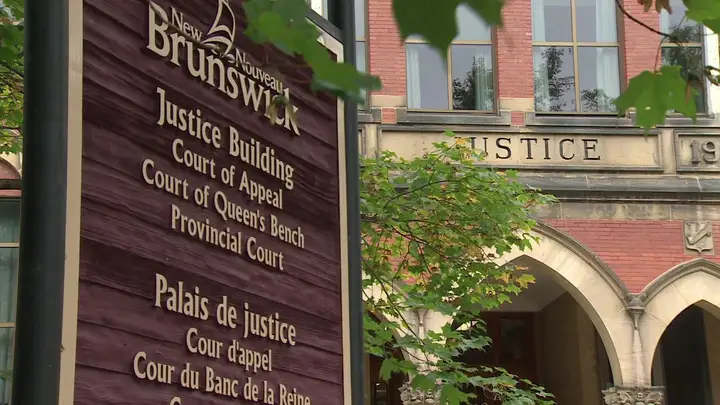
Trainor v. DeArcos, 2025 NBCA 131, shows what an appeal can change. The trial judge awarded Meghan Trainor about $325,000 for injuries from a car accident. In December 2025 the New Brunswick Court of Appeal set that aside and ordered about $2.3 million. The court found three legal errors, and each one had cut the award.
Michael B. Murphy, KC and Shane M. Scott of the Mike Murphy Law Group ran the nine-day trial and argued the appeal.
A 2014 Collision Fractured Her Heel and Led to Chronic Pain and PTSD
On March 27, 2014, Ms. Trainor was 20 and a passenger in her mother’s car when another driver struck them. The driver admitted liability and fought only the amount of damages.
The collision fractured her right heel bone and injured her chest and hand. She developed post-traumatic stress disorder with recurring nightmares about the crash. Over the following months and years her condition got worse. Chronic pain spread through her body. Stress-related teeth grinding produced temporomandibular disorder (TMD), a jaw condition. She had several more surgeries on her right leg.
Before the accident she worked as a waitress and planned to attend community college. Afterwards she could not hold a job, came to need a cane, and more than a decade later still depended on her parents for daily care.
The Trial Judge Made Three Errors That Cut the Award To $325,000
The trial judge accepted that the accident caused every one of these injuries as a matter of fact. She then held that the chronic pain, the TMD and the later surgeries were too “remote” to be compensated in law. That is where the award collapsed to $325,000.
We identified three errors and took the case to the Court of Appeal.
The Judge Applied a Subjective Foreseeability Test
Foreseeability in Canadian negligence law is an objective test. The question is whether a person of “ordinary fortitude” could foreseeably suffer the general type of injury. The question is not whether this plaintiff’s own reaction was predictable. The Supreme Court of Canada settled that in Mustapha v. Culligan.
The trial judge looked at how Ms. Trainor’s own mental health history contributed to her chronic pain. The Court of Appeal called that a subjective test in place of the objective one. Chronic pain, jaw disorders and leg injuries after a motor vehicle collision are not far-fetched. Once the judge accepted that localized pain was foreseeable, the analysis should have stopped.
The Judge Treated a Thin Skull Plaintiff as a Crumbling Skull
Ms. Trainor had depression in partial remission and borderline personality disorder. Both were stable and managed. Her psychiatrist described her as stable 13 days before the collision.
The trial judge labelled her a “crumbling skull” plaintiff and used the label to deny recovery for the chronic pain outright. The Court of Appeal found two problems. First, the crumbling skull doctrine can only reduce an award. It cannot bar one. Second, she was a “thin skull” plaintiff. Her conditions were latent and managed, not deteriorating. Under the thin skull rule the defendant takes the victim as found and pays full damages.
The 40% Discount Double-Counted the Risk of Disability
The trial judge cut future loss of earnings by 40% for Ms. Trainor’s pre-existing vulnerabilities. The actuary had already built general disablement rates into her multipliers. The 40% sat on top of that. No expert evidence supported it. The Court of Appeal found the judge had double-counted the risk of disability.
Trainor v. DeArcos on Appeal: the Court Ordered About $2.3 Million
The Court of Appeal set aside all three errors and ordered damages on the trial judge’s own provisional assessments. The award of about $2.3 million covers general damages, past and future loss of earnings, past and future loss of housekeeping capacity, future care costs and management fees.
That is roughly seven times the trial award. Without the appeal, Ms. Trainor would have received $325,000 for injuries the evidence valued at more than $2.3 million.
Three months later the firm also won the $3.3 million Allen v. Doiron car accident injury claim decision. Those are the two largest personal injury decisions in the region’s history. Both arose from New Brunswick car accident claims, and both are listed on the best injury results page.
Canadian Courts Assess Injury Claims on Causation, Foreseeability and the Thin Skull Rule
The Court of Appeal’s reasoning rests on three settled principles. Anyone with a chronic pain, psychological injury or pre-existing condition claim will meet all three.
Causation Is Proven Twice, in Fact and in Law
A plaintiff must prove causation twice. Factual causation uses the “but for” test on a balance of probabilities: would the injuries have happened but for the defendant’s negligence? The trial judge found factual causation for every injury, and nobody disputed that on appeal.
Legal causation asks whether the injury is too remote. Mustapha v. Culligan sets the standard as a “real risk” that a reasonable person would not brush aside as far-fetched. This is the step the trial judge got wrong.
Foreseeability Is Judged by a Person of Ordinary Fortitude
The court asks whether a person of ordinary fortitude could suffer the general type of injury. It does not look at the plaintiff’s “previous history” or “particular circumstances”. The trial judge did exactly that, the error Mustapha names.
A Thin Skull Plaintiff Recovers in Full and a Crumbling Skull Plaintiff Recovers Less
Athey v. Leonati is the thin skull authority: the tortfeasor takes the victim as found and pays for the full injury, even one worse than an average person would have suffered. A crumbling skull plaintiff, by contrast, had a condition already deteriorating. There the court reduces the award by the measured risk. As the New Brunswick Court of Appeal confirmed in Wallace v. Thibodeau, even then the court must not dismiss a meritorious claim. It reduces it.
The trial reasons contradicted themselves. At paragraphs 297 and 298 the judge said the pre-existing conditions were the “cause” of the chronic pain, and also that they were “well managed” but left Ms. Trainor at greater risk of pain progressing. The second description is a thin skull. So she was entitled to the provisional assessments with no reduction.
The $2.3 Million Is General Damages, Lost Earnings, Housekeeping and Future Care
General damages of $200,000 cover pain, suffering and loss of enjoyment of life. The trial judge had provisionally set $150,000; the appeal added $50,000 to reflect the chronic pain and PTSD.
Past loss of earnings of $183,206 runs from the accident to trial. The heel injury ended her waitressing, and chronic pain then kept her out of any work.
Future loss of earnings of $1,289,716.30 is the largest head. The trial judge’s 40% discount had cut it to $773,829.78. The full figure, with 13% management fees, was restored.
Past loss of housekeeping capacity is $68,737. Future loss of housekeeping capacity is $163,628.82, built on present-value multipliers, a tax gross-up and a 17% management fee.
Future care costs come in three parts. Projected modalities, meaning vocational and ergonomic assessments, total $2,590.75. Aids and services total $260,686.16 for household help, mobility supports, sleep equipment and assistive devices. Medications total $139,985, mostly for PTSD and related conditions. Future care carries a 22% management fee.
The court also ordered the defendant to pay costs of $5,000 plus disbursements.
The 40% Discount Had No Expert Evidence Behind It
The discount had cut future income loss from $1,289,716.30 to $773,829.78, more than $500,000.
The judge applied it for “pre-existing psychiatric vulnerabilities”. The actuary, Jessie Gmeiner, had already used general disablement rates from the most recent Canada Pension Plan valuation. Any further reduction needed evidence from a psychiatrist or psychologist about how much Ms. Trainor’s condition would interfere with future work. There was none. Ms. Gmeiner testified that even if Ms. Trainor were twice as likely as the general population to become disabled, the right adjustment would be a further 3.4%, not 40%.
The Court of Appeal held that the discount rested on a misreading of the actuarial evidence and clashed with the judge’s own findings about Ms. Trainor’s likely career.
Trainor Sets Four Rules for Chronic Pain Claims
Chronic pain is a foreseeable consequence of a car accident, even when it develops months or years after the first injury. A stable pre-existing mental health condition does not bar recovery and should not reduce it. The crumbling skull doctrine can reduce an award but never deny one. And a trial error can be fixed on appeal, here to the tune of about $2 million.
For how chronic pain claims work in practice, read Chronic Pain After a Car Accident: What Your Claim Could Be Worth.
FAQ
How Much Was the Personal Injury Result in Trainor v. DeArcos?
About $2.3 million, ordered by the New Brunswick Court of Appeal: general damages, past and future loss of earnings, housekeeping capacity and future care. The trial court had awarded about $325,000.
What Is the Thin Skull Doctrine in Canadian Personal Injury Law?
The at-fault party takes the victim as found. If a plaintiff had a latent, stable condition such as managed depression, the defendant pays full damages even where the injuries are worse than an average person would have suffered. Trainor applied that rule to chronic pain after a car accident.
Can Chronic Pain Be Compensated After a Car Accident?
Yes. The Court of Appeal confirmed that chronic pain is a reasonably foreseeable consequence of a motor vehicle accident. Pain that develops gradually over months or years is still compensable if the accident caused or contributed to it.
Does the Mike Murphy Law Group Handle Personal Injury Cases on Contingency?
Yes, across New Brunswick, Nova Scotia, Prince Edward Island, and Newfoundland and Labrador. There are no legal fees unless the case is won.
How Do I Know If My Personal Injury Case Is Being Undervalued?
Compare what you have been offered to what the evidence supports, as this case did. If you have been seriously injured in a car accident, contact the Moncton office.