
The Discovery Process Is Questioning Under Oath, Not a Trial
Most clients dread the discovery process more than any other step in the claim. The idea of a defence lawyer questioning them under oath is worse, in their minds, than the injury.
It is a much smaller thing than that fear suggests. An examination for discovery is not a trial. There is no judge and no jury. It is a meeting in a boardroom where the other side asks you questions and a court reporter writes down the answers. Both sides do it. Its purpose is to let each side find out what the other will say before anyone spends money on a trial.
Preparation removes most of the fear. Below is what happens, in the order it happens.
The Discovery Process Lets Each Side Question the Other Under Oath Before Trial
An examination for discovery is a pre-trial step in every New Brunswick civil action. The Rules of Court give each party the right to question the other under oath. The defence uses it to learn how the accident happened, what your injuries are, and how those injuries affect your day. We use our turn to pin down the defendant’s version.
Your answers are recorded and transcribed by a court reporter. If the case goes to trial, that transcript can be read into evidence. If your trial testimony differs from what you said at discovery, the defence will put the two side by side in front of the judge. That is the only real trap in the room, and it is avoided by telling the truth both times.
Six Terms the Defence Lawyer Will Use Without Explaining Them
A handful of terms will be used without explanation, so learn them first.
You are the plaintiff, the person who was injured and started the action. The defendant is the person or company being sued. In a motor vehicle case the defendant’s lawyer is retained and paid by the defendant’s insurer.
Damages means the money you are claiming. General damages compensate pain, suffering and loss of enjoyment of life. Special damages are measurable out-of-pocket losses: prescriptions, mileage to appointments, lost wages.
If your case is a car accident, you will be asked about Section B accident benefits. Those are the no-fault benefits your own auto policy pays for treatment and income replacement. The limitation period is the two-year deadline in New Brunswick to start an action after an injury.
In short:
- Plaintiff. The injured person bringing the action.
- Defendant. The party being sued.
- General damages. Money for pain and suffering.
- Special damages. Repayment of direct financial losses.
- Section B benefits. No-fault benefits under your own auto policy.
- Limitation period. The two-year deadline to start the action.
Who Will Be in the Room?
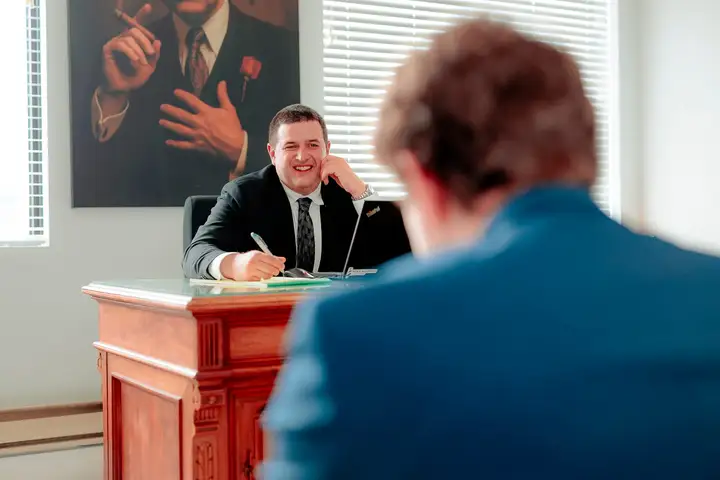
The examination takes place in a boardroom, not a courtroom, usually at the office of your Moncton personal injury lawyers, at the defence lawyer’s office, or at a court reporting firm.
You sit at the table beside your lawyer, with the defence lawyer across from you. The court reporter is at the end of the table, swears you in, and records every word. An insurance adjuster or the defendant sometimes attends. In an ordinary injury claim they rarely do.
You Swear an Oath and the Court Reporter Records Every Spoken Word
Before the first question, the court reporter asks you to swear an oath or affirm. That is a binding promise to tell the truth, and lying under it is perjury.
The reporter records everything on a stenography machine. Nods, head shakes and “uh-huh” do not transcribe. Say “yes” or “no” out loud. Your lawyer will remind you if you slip.
Your Lawyer Rehearses the Questions with You Before the Date
We meet with you before the date. We go through your medical records, the police report and any statement you gave an insurer, so that what you say at discovery matches the documents. We tell you the questions the defence will ask, because after enough of these there are few surprises.
We also practise the mechanics: pause before answering, ask for a question to be repeated if you did not follow it, answer only what was asked. Clients who have done a two-hour preparation session describe the examination itself as an anticlimax.
The Discovery Process Covers Four Topics, Starting with Your Health Before the Accident
Expect four categories. The defence wants a timeline of your life before, during and after the accident.
The first category is your background and health before the accident. Education, work history, where you live and with whom. Then previous injuries, illnesses and chronic conditions.
The defence is looking for a pre-existing condition to blame your symptoms on. Do not hide one. A prior back complaint you disclose is a fact to be argued about. A prior back complaint you deny, and that then turns up in your family doctor’s chart, becomes the whole case.
The Defence Asks How the Accident Happened, and You Do Not Guess
The second category is the event. For a collision or a trip and fall incident, you will be asked about the time, the location, the weather, and what you were doing in the minutes before. What you saw, heard and felt at the moment of impact. What the defendant and any witnesses did.
If you do not remember something, say so. Do not estimate speeds, distances or times you are not sure of. A guess goes into the transcript as your evidence, and if a reconstruction later shows it was wrong, the defence uses it to argue you are unreliable about everything else.
The Defence Asks for Every Injury and Every Gap in Treatment
The third category is medical. You will be asked to list every injury, from the fracture to the bruising, and to describe the treatment: hospital, family doctor, physiotherapy, medication.
The defence will ask whether you followed your doctor’s advice and attended every appointment. If there is a gap in treatment, they will ask why. If the answer is that you could not get a ride, or the physiotherapy hurt too much, say that plainly. An unexplained gap gets argued as proof you were not really hurt.
The Defence Asks What You Can No Longer Do, and Specifics Are the Evidence
The fourth category is how the injuries changed your life, which is the evidence behind general damages. Chores you cannot do, yard work, lifting, hobbies you dropped. Time missed from work and duties you cannot perform now.
Be specific. “I can’t do much anymore” is worth little. “I used to split a cord of wood every fall and I have not touched the axe since the crash” is evidence.
Tell the Truth, Listen to the Whole Question, Answer Only What Was Asked
Tell the truth. Exaggeration is discovered, and once discovered it discounts everything else you say.
Listen to the whole question before answering, then pause. The pause lets you think and gives your lawyer time to object.
Answer the question asked and stop. Do not volunteer. If the question calls for yes or no, give yes or no and wait.
Ask for Unclear Questions to Be Rephrased and Admit What You Do Not Remember
Lawyers phrase questions badly sometimes. If you do not understand one, ask for it to be rephrased. Never answer a question you did not follow.
You will forget details. Accidents get examined months or years after they happened. “I don’t remember” and “I don’t know” are proper answers when they are true. They are not a shield against hard questions, and a transcript full of them reads badly, so use them honestly.
When Your Lawyer Objects, Stop Talking and Wait for Instructions
If the defence asks something irrelevant, unfair or improper, your lawyer will say “objection.” Stop talking. The two lawyers will argue the point on the record. When they finish, your lawyer will tell you either to answer or to refuse. Follow that instruction.
An Undertaking Is a Promise to Produce a Document Later
The defence will ask for things you do not have with you: a pharmacy receipt, the name of a walk-in clinic. Your lawyer gives an undertaking, a formal promise to produce the item later, and the reporter notes it on the transcript.
After the examination we collect the answers with you and send them over. Delay here stalls settlement talks, so we chase undertakings promptly.
The Transcript Arrives Weeks Later and Becomes the Cross-Examination Script
The court reporter produces the transcript a few weeks later. Your lawyer reviews it, and in some cases you will be asked to check it for transcription errors on important facts.
That transcript is the defence’s cross-examination script if the case goes to trial. Any contradiction between it and your trial evidence will be put to you.
Discovery Is Usually What Starts Settlement Talks
Most New Brunswick injury claims settle rather than go to trial, and discovery is usually what starts the settlement talks. After it, the defence lawyer reports to the insurer on how credible you were and how serious the injuries look. That report drives the insurer’s first real offer.
From there your lawyer may propose a settlement conference or mediation. If the offer is not fair, the file goes on toward trial.
The Insurer’s Lawyer Does This Every Week, and the Firm Works on Contingency
Civil procedure in this province is strict, and the insurer’s lawyer does this every week. Their job is to reduce what the insurer pays, and discovery is their best tool for finding a reason to do it.
The Mike Murphy Law Group takes personal injury claims on a contingency basis. No win, no fee. There are no upfront costs, and the firm is paid only out of a recovery.
FAQ
Will I Have to Speak in Front of a Judge During Discovery?
No. There is no judge or jury at an examination for discovery. It takes place in a boardroom with you, the lawyers and a court reporter.
How Long Does the Examination for Discovery Usually Last?
It depends on the case. A straightforward car accident claim takes two or three hours. A complicated liability or medical case can take a full day. You can take breaks.
What Should I Wear to My Discovery Appointment?
Neat, clean, comfortable clothing, the way you would dress for a business casual interview. The defence lawyer is assessing how you will present to a judge, so present well.
Can I Bring Notes or Documents to Look at While Answering Questions?
No. You testify from memory. The defence lawyer may show you documents, such as medical records or the police report, and ask you about them.
What Happens If I Make a Mistake While Answering a Question?
Tell your lawyer. You can correct the record during the examination. If you realize the error afterwards, your lawyer can correct it formally.
Call the Office Before Your Examination Date
If you are facing an examination for discovery, call the office. Preparation is the difference between a hard afternoon and a manageable one.