
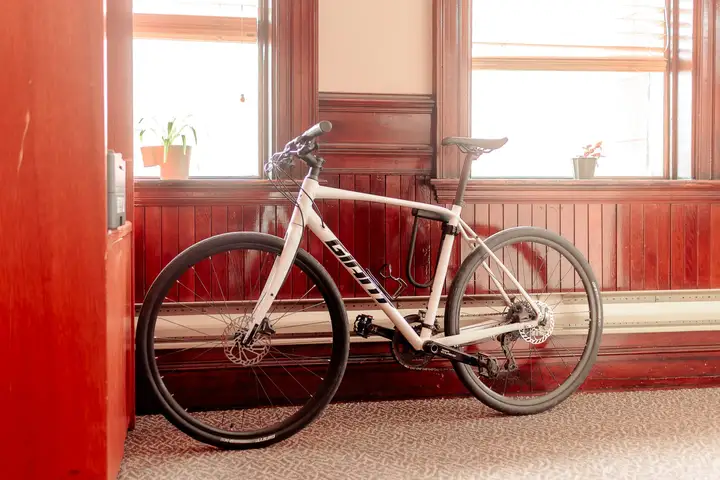
Impaired driving on a bicycle is not an offence under the Criminal Code. The impaired driving sections apply to a conveyance, which the Code defines as a motor vehicle, a vessel, an aircraft or railway equipment, and a bicycle moved by muscular power is none of those. A boat is, an ATV is, a snowmobile is, and a scooter with a motor probably is.
That is the legal answer. It is not the whole answer, because a cyclist who is drunk or high can still be arrested, ticketed and, in some circumstances, charged with something else.
The Criminal Code Covers Conveyances, and a Pedal Bike Is Not One
Section 320.11 of the Criminal Code defines a conveyance as a motor vehicle, a vessel, an aircraft or railway equipment. A motor vehicle is defined in section 2 as a vehicle drawn, propelled or driven by any means other than muscular power.
A bicycle you pedal fails both parts. It has no motor and it moves by muscular power. There is no offence of impaired driving on a bicycle to charge, and there is no lawful breath demand to make, because the demand power in section 320.27 attaches to the operation of a conveyance.
A Boat, an ATV or a Snowmobile Is a Different Answer Entirely
The same section that excludes the bicycle captures almost everything else people ride in this region. A vessel includes a boat, so operating a motorboat after drinking is the same offence as driving a car after drinking. An ATV and a snowmobile are motor vehicles, and the Criminal Code applies on private land as well as public roads.
The consequences follow the criminal charge, which means a driving prohibition that applies to your car even though you were on the water or on a trail. The firm defends those files across both provinces, and they run like any other DUI charge.
An Electric Bike or an E-Scooter Has a Motor, and That Changes the Analysis
The moment a machine is propelled by something other than muscular power, the definition of motor vehicle is in play. An e-scooter and a throttle-driven electric bike are both motorised. Whether a particular device counts turns on how it is powered, how fast it goes and how the province classifies it.
Both Nova Scotia and New Brunswick have added rules for electric kick scooters and power-assisted bicycles, and those provincial rules also carry impaired riding consequences of their own. Treat any motorised device as capable of producing a criminal charge until a lawyer has looked at the specifications.
Provincial Law Still Applies to a Cyclist Who Has Been Drinking
A cyclist on a public road is subject to the rules of the road in both provinces. An officer can ticket a cyclist for riding without lights, for failing to stop, or for riding in a way that endangers other people.
Liquor and public intoxication legislation applies too. A person who is intoxicated in a public place can be arrested and held until sober, and that happens without any charge being laid at all.
Causing a Collision on a Bicycle Can Produce a Criminal Charge That Is Not Impaired Driving
Where a drunk cyclist injures someone, the absence of an impaired driving section does not end the matter. Criminal negligence and assault provisions do not depend on what the accused was riding. The Crown has to prove a marked departure from what a reasonable person would do, and intoxication is part of the evidence it uses.
Charges of that kind are rare and hard to prove. They are also serious, and they are defended the way any criminal charge is defended, by testing the Crown’s proof of the conduct rather than arguing about the vehicle.
Cannabis Does Not Change the Definition of the Vehicle
The drug impaired provisions sit in the same part of the Code and use the same word, conveyance. Riding a bicycle after using cannabis is outside them for the same reason riding after drinking is.
That does not make it safe or sensible, and it does not stop an officer from investigating. If the officer decides the rider was operating something motorised, the investigation will proceed as a drug impaired one, with a field sobriety test or an evaluation by a drug recognition officer.
Being Arrested for Something the Law Does Not Cover Happens More Often Than It Should
Officers get the conveyance definition wrong. A rider is sometimes arrested, screened and released before anyone checks whether the machine was ever within the section.
If that happened to you, the arrest was unlawful and everything obtained from it is open to challenge. Say nothing beyond identifying yourself, ask for a lawyer, and let counsel deal with the demand. The right to counsel chapter explains what the officer had to do at that point.
What the Firm Does with a Charge That Started on Two Wheels
The first step is the definition. If the machine was human powered, the charge is answered by the statute rather than by evidence, and the file should end early.
If the machine was motorised, the case becomes an ordinary impaired driving defence: the grounds for the stop, the timing of the demand, the operation of the device, the right to counsel, and the continuity of the samples. The firm defends charges in New Brunswick and Nova Scotia and takes those files from the first appearance onward. Read what we can do once a charge exists.
FAQ
Can Police Demand a Breath Sample From a Cyclist?
Not on a pedal bicycle. The breath demand power applies to the operation of a conveyance, and a bicycle moved by muscular power is not one. A demand made anyway is unlawful.
Does a Bicycle Offence Affect My Driver’s Licence?
A provincial ticket for a cycling infraction generally does not carry driver’s licence demerits, though the position differs between the two provinces. A criminal conviction arising from a collision can carry a driving prohibition.
What About a Motorised Bicycle with Pedals?
That depends on the motor. A power-assisted bicycle that meets the provincial definition is regulated as a bicycle for some purposes, while a machine that exceeds the limits is treated as a motor vehicle, and the specifications on the machine decide which side of that line it falls on.
Is Riding a Horse After Drinking an Offence?
A horse is not a conveyance and there is no Criminal Code offence. Provincial offences and public intoxication laws still apply, as does liability for any injury caused.